Choosing an Industrial Concrete Supplier in Kansas City for Large Projects
Choosing the right industrial concrete supplier in Kansas City can determine whether your large-scale project stays on schedule and within budget — or faces costly delays and structural risks. For industrial construction, concrete isn’t just material; it’s the foundation of structural integrity, load-bearing performance, and long-term durability. Suppliers that offer on-site mixing, precise yardage control, and flexible scheduling provide a major advantage for warehouses, manufacturing facilities, distribution centers, and large commercial builds.
If your project involves heavy equipment loads, high PSI requirements, or multi-phase pours, selecting the right supplier is critical.
What Makes Industrial Concrete Different?
Industrial projects demand more than standard residential mixes.
Typical industrial applications include:
- Warehouse slab-on-grade floors
- Distribution centers
- Manufacturing facilities
- Loading docks
- Heavy equipment pads
- Structural footings and foundations
These projects often require:
- 4,000–5,000+ PSI concrete
- Reinforcement integration
- Fiber additives
- Extended pour durations
- Precise slump control
According to the American Concrete Institute, proper mix design and placement significantly affect long-term structural performance.
[American Concrete Institute – https://www.concrete.org]
Industrial concrete must be engineered for durability, not just convenience.
Why Supplier Selection Matters for Large Projects
Large industrial pours involve:
- Tight construction schedules
- Coordinated subcontractors
- Inspection timelines
- Heavy machinery staging
- Tenant or operational deadlines
A delay in concrete placement can halt:
- Steel erection
- Framing
- Roofing
- Equipment installation
- Utility integration
Concrete is frequently on the critical path of construction. A reliable industrial supplier helps prevent bottlenecks.
Key Qualities to Look for in an Industrial Concrete Supplier
When evaluating suppliers in Kansas City, consider these critical factors.
1. On-Site Mixing Capability
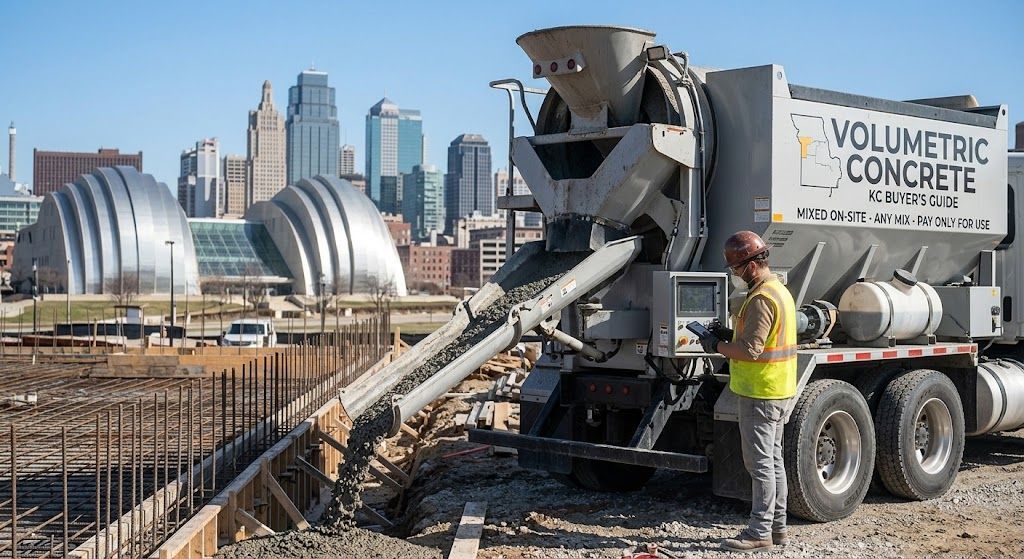
For industrial projects, on-site mixing provides substantial benefits.
Traditional batch plants mix concrete off-site and transport it to your location. During transit, hydration begins immediately.
In Kansas City traffic or extreme temperatures, delays can impact workability and strength.
With on-site mixing:
- Concrete is mixed fresh at the job site
- PSI strength remains consistent
- Slump adjustments can be made in real time
- You only pay for what you use
- Long pours can continue without cold joints
For warehouse slabs or large distribution facilities, this flexibility is invaluable.
2. Experience with High-Volume Pours
Industrial projects may require:
- Hundreds or thousands of cubic yards
- Continuous pouring
- Multi-day coordination
- Sequenced slab placement
Your supplier must be capable of sustaining consistent production without quality fluctuations.
3. Licensed and Insured Operations
Industrial construction involves high liability exposure.
A licensed and insured supplier protects:
- General contractors
- Property owners
- Developers
- Project managers
Never assume coverage — verify it.
4. Flexible Scheduling & Extended Availability
Industrial projects don’t always follow standard business hours.
Weather delays, inspection changes, or subcontractor coordination may require:
- Early morning pours
- Extended hours
- Weekend scheduling
Flexible suppliers reduce timeline pressure.
Kansas City Climate Considerations for Industrial Concrete
Kansas City experiences significant seasonal variation:
- Freezing winter temperatures
- Hot, humid summers
- Sudden weather shifts
Temperature directly impacts:
- Set time
- Strength development
- Surface finish
- Long-term durability
The Portland Cement Association emphasizes the importance of temperature control during placement.
[Portland Cement Association – https://www.cement.org]
On-site mixing allows immediate adjustment of:
- Water ratios
- Accelerators
- Retarders
- Air entrainment
For large industrial slabs, these adjustments can prevent cracking and long-term structural issues.
Cost Control for Large Industrial Projects
Industrial projects operate on tight margins.
Hidden costs associated with traditional delivery include:
- Overordering waste
- Short-load penalties
- Returned concrete disposal
- Idle labor due to delays
On-site mixing helps reduce these risks because:
- Exact yardage is delivered
- Continuous pour control is possible
- Adjustments prevent material waste
For high-volume projects, even small percentage savings add up significantly.
Industrial Concrete Strength & Specifications
Large-scale industrial projects often require:
- 4,000–5,000 PSI compressive strength
- Reinforced fiber integration
- High durability against heavy loads
- Surface flatness standards (FF/FL ratings)
Proper coordination between supplier and contractor ensures mix design aligns with structural engineering requirements.
Failing to meet specifications can lead to:
- Inspection failures
- Surface cracking
- Load-bearing deficiencies
- Expensive remediation
Choosing the right supplier minimizes these risks.
Questions to Ask Before Hiring an Industrial Supplier
Before committing, ask:
- Do you offer on-site mixing?
- Can you handle high-volume continuous pours?
- Are you licensed and insured?
- What PSI strengths can you produce?
- Can you adjust mix design based on weather?
- Do you provide flexible scheduling?
Clear answers protect your project.
Who Benefits Most from a High-Quality Industrial Supplier?
- General contractors
- Commercial developers
- Industrial facility owners
- Manufacturing operations
- Distribution center builders
Large industrial facilities in the Kansas City metro area require dependable, scalable concrete solutions.
Frequently Asked Questions
What PSI is typical for industrial concrete?
Most industrial floors require 4,000–5,000 PSI, depending on load requirements.
Is on-site mixing better for large projects?
Yes. It provides flexibility, reduces waste, and improves strength consistency during long pours.
Can industrial suppliers handle phased construction?
Experienced suppliers coordinate multi-phase pours and extended timelines.
Does weather affect industrial concrete placement?
Yes. Temperature impacts curing time and performance, making real-time mix adjustments valuable.
How do I request a quote?
Provide project size, PSI requirements, timeline, and location for an accurate estimate.
Secure a Reliable Industrial Concrete Supplier in Kansas City
Large projects demand precision, reliability, and performance. Industrial concrete isn’t an area where shortcuts pay off.
Look for a supplier that offers:
- On-site mixing
- High-volume capacity
- Licensed and insured service
- Flexible scheduling
- Real-time mix adjustments
If you’re planning an industrial or large commercial project in Kansas City, call +1 (816) 432-3200 to request a free estimate and discuss your project timeline.
The right supplier helps protect your schedule, your structure, and your bottom line.